
Filaments: Handling and Storage
How to store filament correctly: moisture control, recommended temperatures, and protection from UV to preserve printability.
⏱ Estimated time: 5 min
Procedure
The Right Conditions
The filament is hygroscopic—it absorbs water. Store it properly for best results.
🌡️ Storage Conditions
How to Store Filament Properly at Home
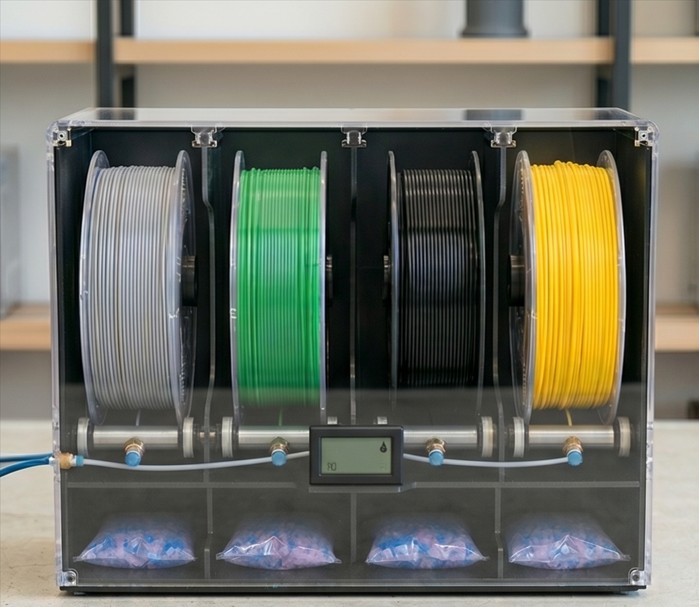
Closed box + silica gel = the basis of every home storage
Each filament absorbs moisture from the air at a different rate. PLA can withstand it longer, while nylon absorbs moisture in a single night.
- Recommended humidity
- < 30% RH (ideally < 15% inside the box)
- Storage temperature
- 59 - 77 °F, no direct sun
- Silica gel
- 100-200 g per resealable box (10-15 l)
- Replacing the silica gel
- Every 3-6 months or when saturated (color indicator)
The simplest solution: Ziplock bags or plastic boxes with seals + a few bags of silica gel. Cheap, functional, easily expandable.
Humidity indicators: Use this recommendation while configuring your print.
UV light: Direct sunlight degrades PLA and causes embrittlement. A dark box or dark bag will protect you.
🔥 Drying the filament before printing
When and How to Dry Filament
Popping and bubbling at the nozzle = wet filament, not a bad printer
A damp filament prints unpredictably—resulting in a poorer surface finish, stringing, and weaker mechanical properties. Drying is a cheap and quick solution.
- PLA
- 113 - 122 °F po dobu 4–6 h
- PETG
- 149 °F for 6-8 h
- ABS / ASA
- 176 °F for 4-6 h
- TPU
- 140 °F for 4-6 h
- Nylon (PA)
- 176 °F for 8-12 h
- Compatible devices
- Sunlu S1 Plus, Bambu AMS drying, food dryer
A food dehydrator as an alternative: An inexpensive food dehydrator with precise temperature control works great. Check the calibration with a thermometer - not every dryer keeps the exact temperature.
Filament dryer during printing: For nylon and TPU, it is ideal to print directly from the dryer - the coil absorbs moisture from the air even during printing.
Oven It works, but the risk of overheating is higher. Do not exceed the recommended temperature and leave the door ajar.
How to Tell if a Filament Is Damp During Printing
Hissing, crackling and dull surface = moisture
Moisture in the filament causes typical symptoms that are easy to recognize.
Hissing or crackling: The water in the filament turns to steam in the nozzle and causes an audible crackling sound.
Matt or rough surface: Instead of a glossy or satin surface, a grainy, matte texture is created.
Increased stringing: The water vapor creates overpressure in the nozzle - the fibers stretch more than usual.
Bubbles and Craters: There are tiny craters or bubbles on the print surface, especially for PETG and nylon.
📦 Materials and Storage Priorities
Which materials require the most careful storage?
Nylon absorbs moisture in 24 h | PLA can withstand weeks in the air
The hygroscopicity of materials varies significantly. Listed from the most sensitive to the most resistant.
- Nylon (PA)
- 🔴 Extremely hygroscopic - dry before each print
- TPU / TPE
- 🟠 Very hygroscopic - store in a box, dry
- PETG
- 🟡 Medium - box recommended, dry after longer storage
- ABS / ASA
- 🟡 Medium - box recommended
- PLA
- 🟢 Relatively durable - the box will extend its service life
One coil rule: Always open only the coil you are currently using. Leave the others in a sealed package or box.
The best investments under 500 Kč: Plastic box with seal + indicator silica gel + cheap hygrometer. It lasts for years and the filament stays dry.