
TPU, Nylon and elastomers
Overview of flexible materials: properties, printing tips and common applications for TPU, Nylon and related elastomers.
⏱ Estimated time: 10 min
Procedure
Elastic Materials
For housings, seals, and mechanical parts.
🔬 Properties of TPU and Flexible Materials
What is TPU, and how does it differ from rigid filaments?
TPU 95A = rigid rubber | 85A = soft rubber – Shore A determines the hardness
TPU (thermoplastic polyurethane) is the most widely used flexible material for 3D printing. Its Shore A hardness determines how flexible it is.
- TPU 95A
- Harder rubber - cases, protectors, dampers | Easier to print
- TPU 85A
- Softer rubber - seals, grips, ergonomic elements | Harder printing
- Filaflex (60–82A)
- Very Soft - Footwear, Apparel, Medical Applications | DD required
Direct Drive is a must: TPU builds up and jams in the Bowden extruder. Almost all modern printers have Direct Drive (Bambu, Prusa MK4, Ender with upgrades).
Low print speed: Print TPU at 0.6-1.6in/s. High speed causes under-extrusion and jamming in the extruder.
TPU drying: TPU absorbs moisture. Dry for 6 h at 122 °F before printing. Symptom of wet TPU: cracking and bubbles in the extrusion.
💡 Tips for Successful TPU Printing
Slicer Settings for TPU
Minimum retraction = base | Gyroid infill = the most flexible filling
TPU has specific slicer settings compared to rigid filaments.
- Nozzle temperature
- 428 - 464 °F (depends on the manufacturer)
- Pad Temperature
- 86 - 122 °F or without heating
- Retraction
- 0-0.04 in - minimal or none
- Infill for flexibility
- Gyroid or Honeycomb 10-30%
Minimum retraction: The TPU stretches and jams during retraction. Set to a maximum of 0.04 in or turn retraction off completely. Cobwebs can be solved at a higher travel speed.
Gyroid infill for flexibility: Gyroid pattern maintains flexibility in every direction. Honeycomb is an alternative. Rectilinear infill reduces flexibility.
Removing the TPU from the pad: TPU has excellent adhesion to PEI and textured sheets. Allow to cool to room temperature - it will peel off easier.
🎯 Typical Applications of Flexible Materials
Where TPU and Elastomers Really Shine
Phone case in 2 hours of printing = a classic project to start with TPU
The most popular and most practical applications of flexible filaments.
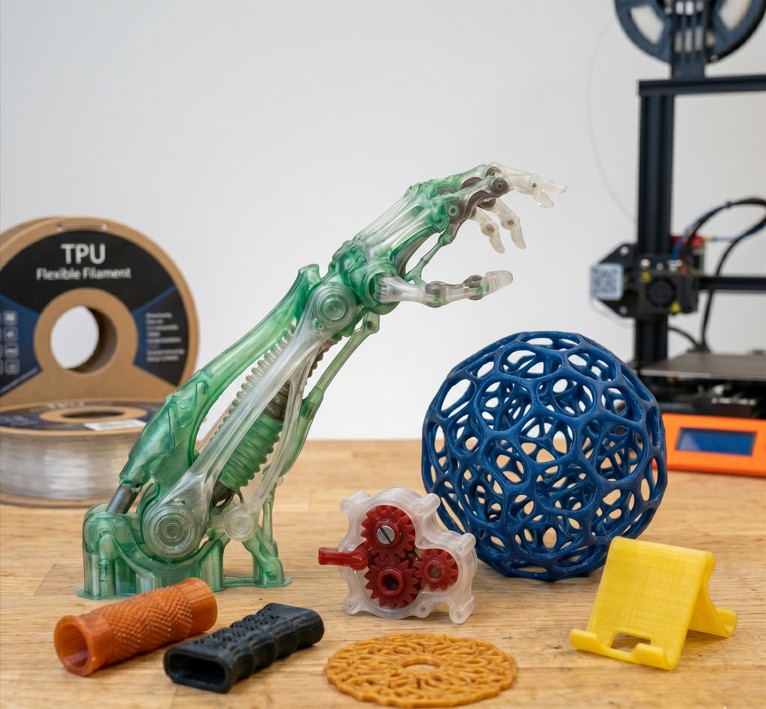
Protective cases: Cases for phones, tablets, cameras. TPU 95A is ideal – stiff enough for protection but flexible for deployment.
Seals and vibration dampers: Seals for 3D printers, anti-vibration pads for printer feet, axis dampers. TPU 85A or Filaflex.
Ergonomic grips and handles: Tool handles, ergonomic button covers, non-slip treads. Combination of rigid internal structure and TPU surface.
Special applications: Footwear and insoles (Filaflex 60A), joint protectors for sports, medical devices (biocompatible TPU variants).